Private Limited Company Directors and ESOPs
Director remuneration and dividend route comparison, ESOP valuation in unlisted companies, Section 80-IAC startup benefits and deferral, Section 2(22)(e) deemed dividend trap, founder exit taxation, phantom stock and SARs, LLP versus Pvt Ltd choice, and director ITR disclosures
- Compute the tax efficiency of salary versus dividend routes for founder-directors, including the three-stage tax comparison and the impact of DDT abolition under Finance Act 2020
- Determine FMV of unlisted company ESOPs using Rule 3(8), calculate perquisite tax and cash flow at exercise, and trace the full LTCG computation at sale
- Apply Section 80-IAC ESOP perquisite tax deferral under Section 192(1C), identify the three trigger events that end the deferral, and explain the cash flow alignment benefit
- Identify Section 2(22)(e) deemed dividend triggers for closely-held companies, apply the substantial shareholder threshold, and use avoidance approaches
- Compute capital gains tax on founder exit for cash sale and share swap scenarios, apply the post-Budget 2024 LTCG rate, and apply the ₹2 crore surcharge threshold
- Distinguish phantom stock and SARs from actual ESOPs and identify how tax treatment differs for cash-settled versus equity-settled compensation
- Select the correct ITR form for director scenarios and complete Schedule DI and unlisted share disclosures
Private Limited Company Directors and ESOPs
India's startup ecosystem has created a new class of taxpayers: founders, early employees, and directors of private limited companies who hold equity, receive variable compensation, and face tax issues quite different from traditional salaried filers. The rules around director remuneration, deemed dividends, ESOPs in unlisted companies, and exit events are nuanced — and the stakes are often substantial, with single transactions potentially involving crores of rupees in tax.
This lesson covers the tax framework for private company directors and employees holding equity. The interplay between director salary, sitting fees, dividends, and loans creates planning opportunities (and traps). The Section 80-IAC eligible startup framework offers significant tax benefits including ESOP tax deferral, but qualification is narrow. Founder shares acquired at incorporation have specific cost basis considerations that affect exit taxation by crores.
Beyond the tax mechanics, this lesson addresses practical questions: when does a "loan from company" become taxable income? How are unlisted shares valued for ESOP perquisite tax when there's no market price? What happens tax-wise when the company gets acquired (acqui-hire, share swap, cash buyout)? How does the LLP vs Pvt Ltd choice affect founder taxation?
A reminder: this lesson uses Income Tax Act 1961 references applicable to FY 2025-26 income filed as AY 2026-27.
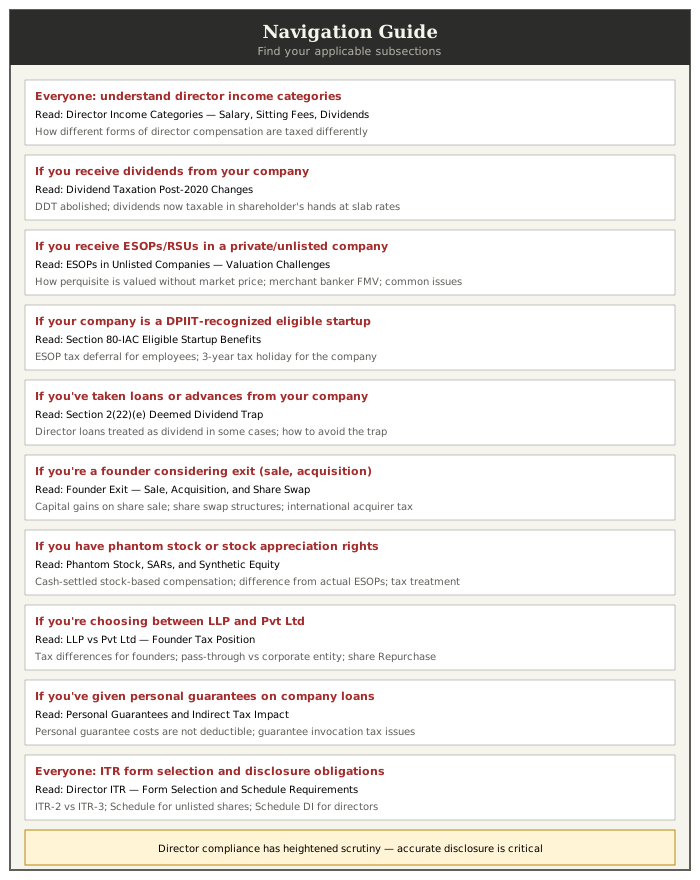
Navigation guide — which subsections apply to your situation
Director Income Categories — Salary, Sitting Fees, Dividends
A director can receive income in multiple forms, each with different tax treatment.
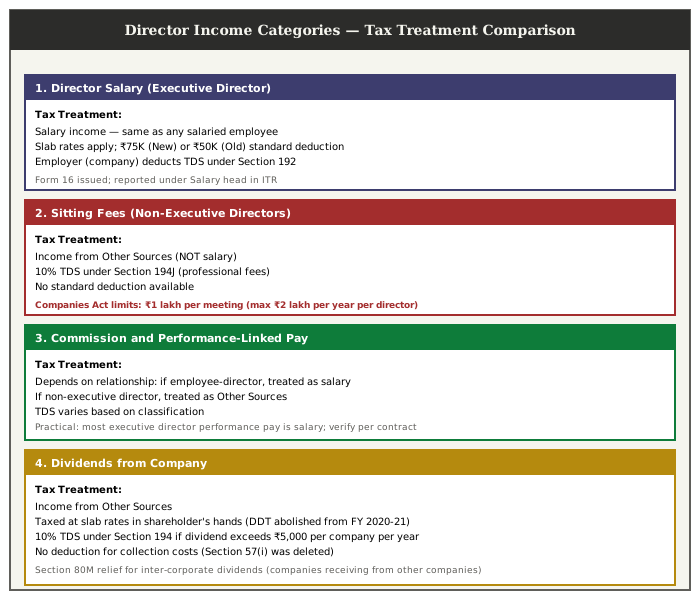
Why the classification matters.
A founder-director taking salary + dividends from their own company can structure compensation:
- Salary: deductible expense to company; taxable salary income for director
- Dividend: not deductible to company (paid from after-tax profits); taxable income for director
Tax flow comparison:
- Salary route: ₹100 deductible expense → ₹74 director (after 26% effective tax)
- Dividend route: ₹100 dividend → company already paid 25% corporate tax on it → ₹75 distributed → ₹55 to director (after 26% effective tax)
Salary is generally more tax-efficient. But excessive director salary draws scrutiny — must be "reasonable" relative to services rendered.
Sitting fees limits. Under Companies Act 2013, sitting fees per board meeting cannot exceed ₹1 lakh, and total per director per year typically caps at ₹2 lakh. Higher payments may not be legally valid.
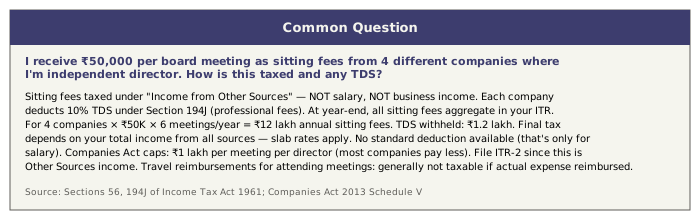
Section 17 (Salary), Section 194J (TDS on professional fees), Section 194 (Dividend TDS), Companies Act 2013 Schedule V.
Dividend Taxation Post-2020 Changes
A foundational change introduced in Finance Act 2020 — dividends are now taxable in shareholders' hands, not at the company level.
Before April 2020. Company paid Dividend Distribution Tax (DDT) at 15% + surcharge + cess. Dividend received by shareholders was tax-free (within limits).
After April 2020. DDT abolished. Dividends taxed in recipient's hands at applicable slab rates.
Tax implications for directors holding shares in their own company.
Example. Founder owns 100% of company. Company profit ₹1 crore. After tax (25% corporate rate): ₹75 lakh. Scenario A — Retain in company. Company tax already paid: ₹25 lakh ₹75 lakh remains as retained earnings or for business reinvestment No further tax until distributed Scenario B — Distribute as dividend. ₹75 lakh distributed TDS 10% (above ₹5K threshold): ₹7.5 lakh withheld Founder receives ₹67.5 lakh Founder's tax at marginal rate (assume 30% bracket): ₹22.5 lakh Net to founder: ₹75 lakh - ₹22.5 lakh = ₹52.5 lakh Total tax (company + founder): ₹25 lakh + ₹22.5 lakh = ₹47.5 lakh (47.5% effective on ₹1 crore) Scenario C — Salary route. Company pays ₹1 crore salary to founder Company gets ₹1 crore deduction → effectively zero corporate tax on that ₹1 crore Founder pays tax on ₹1 crore salary at slab rates Founder's tax: approximately ₹30 lakh Net to founder: ₹70 lakh Total tax: ₹30 lakh (30% effective)
Practical takeaway. For founder-controlled companies, salary route is more tax-efficient than dividend route. But salary requires actual services and reasonable amounts.
Section 80M — Inter-corporate dividends. When Company A receives dividend from Company B (both Indian companies), Company A can claim deduction for dividends it pays onward to its own shareholders. Prevents cascading tax. Relevant for holding company structures.
TDS on dividends paid abroad. Dividends paid to non-resident shareholders: 20% (or per DTAA) TDS at higher of these rates. Documentation requirements increase.
Sections 10(34), 115BBDA (repealed); Section 80M; Section 194; Finance Act 2020.
ESOPs in Unlisted Companies — Valuation Challenges
ESOP taxation principles are the same for listed and unlisted companies (covered in Lesson 10), but practical valuation issues are starkly different for unlisted shares.
The valuation problem. For listed shares, FMV at exercise/vesting is simply the market price on that date. For unlisted shares (private companies), there's no market price — but the law still requires FMV for computing perquisite.
Rule 3(8) — FMV determination for unlisted shares.
For ESOP perquisite computation in unlisted companies, FMV is determined by:
- A category I Merchant Banker registered with SEBI
- Using valuation methodologies prescribed by SEBI/RBI
- Date of valuation: date of exercise (not date of grant)
Common valuation methodologies.
- Discounted Cash Flow (DCF) — projection-based
- Comparable Companies Method — using listed peers
- Last Round Pricing — using recent funding round valuation
- Net Asset Value — for asset-heavy businesses
Practical issues.
- Issue 1: Valuation is expensive. Merchant banker reports typically cost ₹50,000-₹2 lakh per valuation. For small companies with few ESOP exercises, this can be substantial overhead.
- Issue 2: Valuation is contested. What's reasonable FMV is judgment-based. Different valuers give different figures. Tax department may question valuations during scrutiny.
- Issue 3: Funding round mismatches. If FMV at exercise is much higher than ESOP grant price, perquisite is large. But if shares aren't liquid, employee has tax liability with no cash.
The cash flow problem.
An employee exercises 10,000 options at ₹50 strike price when merchant banker FMV = ₹500. Perquisite: ₹4.5 lakh per 1,000 shares = ₹45 lakh TDS at 30%: ₹13.5 lakh withheld (often deducted from other salary) Employee owns 10,000 illiquid shares Cash outflow: ₹5 lakh strike price + ₹13.5 lakh TDS = ₹18.5 lakh Cash inflow: zero until shares can be sold (could be years)
This is why Section 80-IAC eligible startup deferral (covered next) is so valuable.
Capital gains when shares are eventually sold.
- Holding period from exercise to sale
- Long-term if held > 24 months (unlisted shares)
- LTCG rate: 12.5% without indexation (post-Budget 2024)
- Or 20% with indexation for shares acquired before July 23, 2024 (filer's choice)
Worked example showing full lifecycle. Employee receives ESOPs in startup, exercises in 2023 at ₹50 strike when FMV ₹500. Holds shares. Company acquired in 2026 at ₹3,000 per share. At exercise (2023). Perquisite: ₹450 × 10,000 shares = ₹45 lakh Tax at 30%: ₹13.5 lakh Cost basis: ₹500 per share At sale (2026). Holding period: 3 years (long-term) Sale price: ₹3,000 per share Cost basis: ₹500 per share LTCG: ₹2,500 × 10,000 = ₹2.5 crore Tax at 12.5% (no indexation, acquired post-July 2024): ₹31.25 lakh Total tax over both stages: ₹13.5 lakh + ₹31.25 lakh = ₹44.75 lakh. Employee receives net ₹3 crore - ₹44.75 lakh - ₹5 lakh strike = ~₹2.5 crore net.
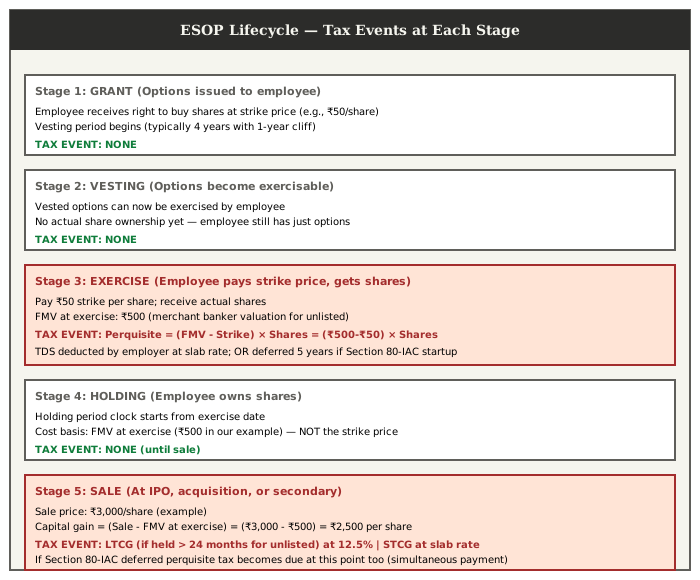
Section 17(2)(vi) of Income Tax Act 1961; Rule 3(8) of Income Tax Rules; CBDT ESOP guidance for unlisted shares.
Section 80-IAC Eligible Startup Benefits
A specific framework providing significant tax benefits to qualified startups and their employees.
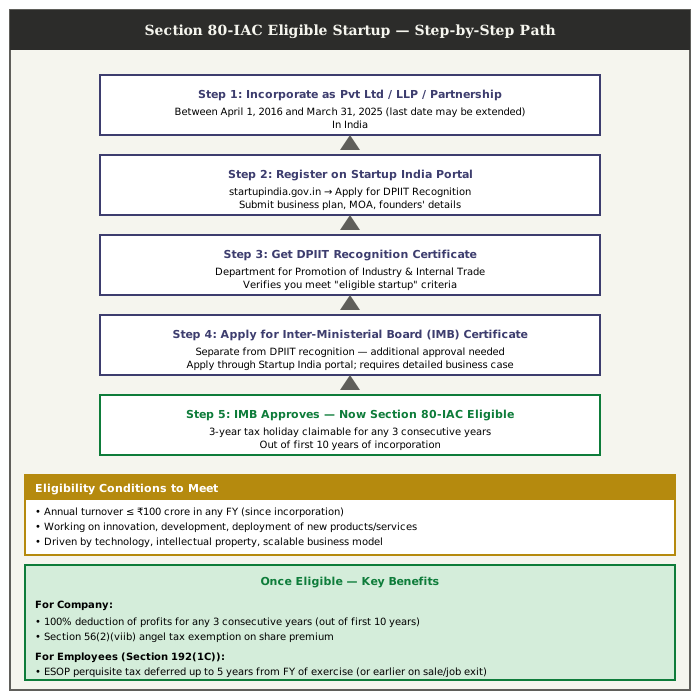
What is a Section 80-IAC eligible startup? A startup recognized by DPIIT (Department for Promotion of Industry and Internal Trade) AND issued an "Inter-Ministerial Board Certificate" qualifying it under Section 80-IAC.
Eligibility conditions.
- Incorporated as a Private Limited Company, LLP, or partnership firm
- Incorporated on or after April 1, 2016, and before April 1, 2025 (last date may be extended)
- Annual turnover not exceeding ₹100 crore in any FY
- Working on innovation, development, deployment, or commercialization of new products/services driven by technology or intellectual property
- Has obtained Inter-Ministerial Board (IMB) certificate
Benefit 1: 3-year tax holiday for the company.
Eligible startup gets 100% deduction of profits from Section 80-IAC for any 3 consecutive years out of the first 10 years of incorporation. Essentially zero corporate tax for those 3 years.
Benefit 2: ESOP perquisite tax deferral for employees.
Under Section 192(1C), employees of Section 80-IAC eligible startups can defer ESOP perquisite tax to the EARLIEST of:
- 5 years from end of FY of exercise
- Date of selling the shares
- Date of leaving the employment
Why this is significant.
Standard ESOP perquisite tax is due at exercise — creating cash flow issues. With deferral:
- Employee exercises options without immediate TDS burden
- Can hold shares for up to 5 years before paying tax
- If shares appreciate, tax is paid on original perquisite value (not current value)
- If company goes public or gets acquired before 5 years, tax becomes due then
Worked example with deferral. Same scenario as before — exercise in 2023, but eligible startup with deferral: At exercise (2023). No TDS, no immediate tax. Cost basis: ₹500 per share. Perquisite: ₹45 lakh (deferred). Acquisition in 2026 (sale event). Deferral period ends. Perquisite tax now due: ₹45 lakh × 30% = ₹13.5 lakh LTCG: ₹2,500 × 10,000 = ₹2.5 crore at 12.5% = ₹31.25 lakh Tax paid simultaneously with sale proceeds — cash flow matches
The cash flow alignment is a major benefit. Employee doesn't pay perquisite tax until they have cash from the share sale.
Other benefits for 80-IAC startups.
- Section 56(2)(viib) angel tax exemption — share issue at premium above FMV doesn't trigger tax for the company
- Carry forward of losses despite shareholding changes (relaxed under Section 79)
- Faster patent processing
- Self-certification under labor laws
How to obtain certification.
- Register on Startup India portal (startupindia.gov.in)
- Apply for DPIIT recognition
- After recognition, apply for Inter-Ministerial Board certification
- Process can take 3-6 months
- Annual renewal required
Section 80-IAC, 192(1C), 56(2)(viib), 79 of Income Tax Act 1961; DPIIT startup recognition guidelines.
Section 2(22)(e) Deemed Dividend Trap
One of the most consequential traps for closely-held company directors and shareholders.
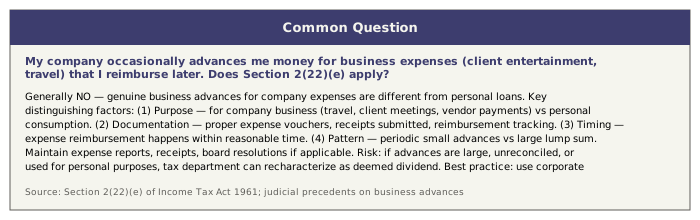
The rule. Under Section 2(22)(e), certain loans or advances from a closely-held company to a substantial shareholder (or to a concern in which such shareholder has substantial interest) are deemed to be dividends — taxable in shareholder's hands.
Who is affected.
- Substantial shareholders: those owning 10% or more of equity shares
- Including spouse, minor children (where shares attributed)
- Including HUF where shareholder is karta
What counts as deemed dividend. Loan or advance to:
- A substantial shareholder
- A concern (firm, HUF, etc.) in which substantial shareholder has at least 20% interest
- Any person on behalf of, or for the individual benefit of, substantial shareholder
Limit on deemed dividend. Deemed dividend cannot exceed the company's accumulated profits at the time of loan/advance.
Tax treatment.
- The loan/advance amount is treated as dividend
- Taxable in shareholder's hands at slab rates (post-2020 changes)
- No DDT (since the company's "phantom" payment isn't really cash distribution)
Common scenarios where 2(22)(e) is triggered.
Scenario 1. Founder takes ₹50 lakh "loan" from his company. Company has ₹2 crore accumulated profits. Result: ₹50 lakh deemed dividend in founder's hands. Scenario 2. Founder's wife (jointly hold 15% shares) takes ₹20 lakh advance from the company. Company has ₹2 crore profits. ₹20 lakh deemed dividend. Scenario 3. Founder's HUF has a tour company. Main company gives ₹30 lakh advance to tour company "for business purposes." Founder substantial shareholder in both. ₹30 lakh deemed dividend.
How to avoid the trap.
- Approach 1 — Don't take loans/advances from your own closely-held company. Take salary or bona fide dividends.
- Approach 2 — Use third-party financing. Borrow from banks instead of from your own company.
- Approach 3 — Structure as business transactions. Arms-length business arrangements (not gratuitous advances) may not trigger 2(22)(e) — but documentation must be strong.
- Approach 4 — Repay before year-end. Some interpretations suggest loans repaid before assessment year close may avoid deemed dividend treatment — though law is conservatively applied. Don't rely on this.
Exemption. Loan to substantial shareholder in the "ordinary course of business" by a company whose business is money-lending is exempt. Limited applicability — only NBFCs/banks.
Inter-company loans risk. Founder of two companies may use inter-company loans for working capital. If both have common substantial shareholder, 2(22)(e) can apply to the lending company. Common scrutiny point.
Section 2(22)(e) of Income Tax Act 1961; CBDT clarifications and judicial precedents.
Founder Exit — Sale, Acquisition, and Share Swap
When the company is sold, founders' tax positions are often substantial and complex.
Types of exit events.
- Cash sale of shares. Founder sells their shares to acquirer for cash. Simplest tax structure. Capital gains tax on the difference between sale price and cost basis.
- Acquisition with cash consideration to company. Acquirer pays the target company (not directly to founders). Target company distributes proceeds as buyback or special dividend. Different tax treatment than direct share sale.
- Stock-for-stock acquisition (share swap). Founder receives shares of acquirer in exchange for target company shares. Limited tax deferral options in India (unlike US). Generally treated as taxable exchange at FMV.
- Cash + Stock combination. Mix of cash and acquirer shares. Cash portion: immediate capital gains. Stock portion: deemed sale at FMV; tax on both components.
Capital gains computation on founder exit. For shares acquired at incorporation (founder shares):
- Cost basis: usually nominal value (e.g., ₹10 per share)
- Held for many years typically (long-term)
- Massive gain at exit
Worked example. Founder owns 1 crore shares acquired at ₹10 each (cost ₹10 crore). Company sold; founder receives ₹50 per share = ₹50 crore. Capital gain = ₹50 crore - ₹10 crore = ₹40 crore Long-term (held > 24 months for unlisted shares) Tax at 12.5% without indexation (post-Budget 2024): ₹5 crore Cess 4%: ₹20 lakh Total tax: ₹5.2 crore If sale is over ₹2 crore, 15% surcharge applies on tax (not income) for individuals: Surcharge: ₹5 crore × 15% = ₹75 lakh Plus cess on tax + surcharge: ~₹23 lakh Total tax: ~₹5.98 crore
Share swap tax.
In share-for-share acquisitions:
- Founder's shares deemed sold at FMV of acquirer shares received
- Tax on capital gain at that point
- Cost basis in new shares = FMV at acquisition (the price at which gain was computed)
This creates immediate tax liability even though founder received no cash — only paper.
Section 47(vii) exception. Mergers and amalgamations (not acquisitions) may qualify for no-tax treatment if specific conditions met (Section 47(vii)). Doesn't typically apply to ordinary acquisitions.
International acquirer considerations.
When the acquirer is a foreign entity:
- Indian tax still applies to Indian founder's capital gains
- Withholding mechanism complex
- Possible DTAA implications
- TDS under Section 195
Pre-exit tax planning.
Common strategies:
- Transfer shares to family members before exit to use multiple basic exemptions (though clubbing risks)
- Use Section 54F if proceeds invested in residential property
- Use Section 54EC for ₹50 lakh tax-free bond investment
- Time exit across tax years to manage tax payment
Sections 45, 47(vii), 49, 50CA, 54F, 54EC, 195 of Income Tax Act 1961.
Phantom Stock, SARs, and Synthetic Equity
Some companies provide stock-linked compensation without actually issuing shares.
Phantom Stock.
- Notional shares allocated to employee
- Employee gets cash payout based on share appreciation
- No actual share ownership
Stock Appreciation Rights (SARs).
- Right to receive cash equal to appreciation in stock price over a base price
- Similar to options but cash-settled
- No actual share purchase or ownership
Tax treatment.
Both phantom stock and SARs are typically:
- Cash payouts when triggered
- Treated as salary or business income (not capital gains)
- Slab rates apply (no special LTCG rate)
- TDS deducted at payment
Why companies use these.
- Avoid actual dilution of shareholding
- Simpler valuation (no merchant banker required)
- Cash-settled (no share issuance complexity)
- Useful for unlisted companies wanting to incentivize without IPO
Why employees may prefer actual ESOPs.
- Capital gains rate on sale (12.5% vs slab rate on phantom)
- Long-term wealth creation through ownership
- Voting rights, dividends from actual shares
Common compensation mix.
- Founders prefer ESOPs (capital gains rate at exit)
- Senior management often gets mix of ESOPs + SARs
- Lower-level employees may get phantom stock for liquidity
Sections 17, 28 of Income Tax Act 1961; general business income principles.
LLP vs Pvt Ltd — Founder Tax Position
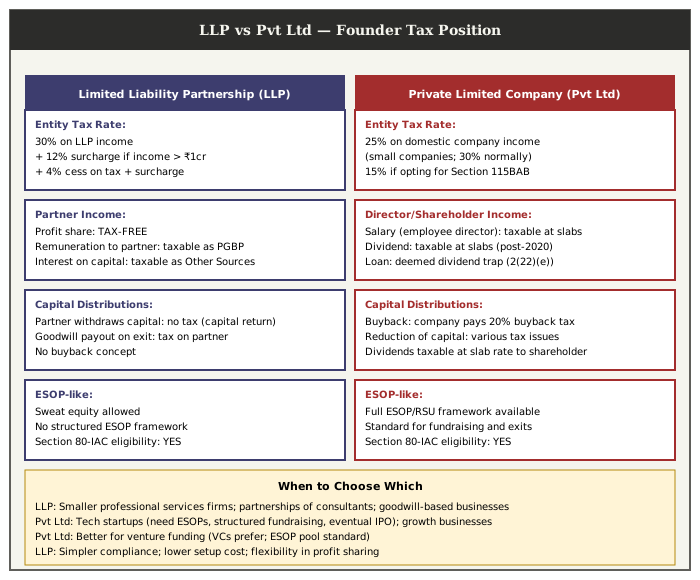
The choice between Limited Liability Partnership and Private Limited Company affects founder taxation significantly.
Conversion considerations.
- LLP to Pvt Ltd conversion: Possible under specific conditions (no immediate tax if conditions met under Section 47).
- Pvt Ltd to LLP conversion: Subject to specific conditions; tax-neutral only if revenue, balance sheet, voting rights conditions met.
Most tech startups today incorporate directly as Pvt Ltd given anticipated need for ESOPs, fundraising, and possible IPO.
Sections 47(xiii), 47(xiv) of Income Tax Act 1961; LLP Act 2008; Companies Act 2013.
Personal Guarantees and Indirect Tax Impact
Founders often give personal guarantees on company loans. Tax implications are limited but worth understanding.
No deduction for guarantee costs. If you pay a guarantee fee to a bank/insurer, it's not deductible against your personal income (since it's company's loan, not yours).
Guarantee invocation — tax implications.
If the company defaults and you have to pay under your personal guarantee:
- Your payment is an "expenditure" from personal funds
- Generally not deductible against personal income
- May qualify as "bad debt" if you have a documented claim against the company (rarely successful)
Practical considerations.
Personal guarantees create:
- Personal financial liability without tax deduction
- Risk of personal bankruptcy
- Need for careful loan structuring
Indirect tax benefit possibility.
If guarantee invocation forces a tax loss (you fund company to keep it alive, eventually shut down):
- May qualify as capital loss on share investment if shares become worthless
- Section 50 treatment for write-off of shares
In practice, guarantee-related tax planning is reactive (after invocation) rather than proactive.
General principles of tax law; capital loss provisions under Sections 45-55.
Director ITR — Form Selection and Schedule Requirements
Directors of unlisted companies have specific disclosure obligations.
ITR form selection.
| Director Type | ITR Form |
|---|---|
| Executive director earning salary only | ITR-1 (if income ≤ ₹50 lakh) or ITR-2 |
| Director with capital gains, multiple income | ITR-2 |
| Director with business/professional income | ITR-3 |
| Director-shareholder of unlisted company | ITR-2 (mandatory if holding unlisted shares) |
Mandatory Schedule for unlisted shares. ITR-2 and ITR-3 have Schedule HP (House Property) and Schedule CG (Capital Gains). Additionally, directors of unlisted companies must complete:
Schedule for shares held in unlisted companies.
- Name of company
- Type of share (equity, preference)
- Opening balance, acquisitions, sales during year
- Closing balance
- Cost of acquisition
- Bonus shares, splits
Schedule DI — for Directors. Disclosure of directorship in any company:
- Name and PAN of company
- Whether listed or unlisted
- Type of directorship
- Period of directorship during the year
Why disclosure matters.
- Helps tax department track director income across companies
- Identifies potential 2(22)(e) loan transactions
- Establishes substantial shareholder status
ITR instructions; CBDT notification on Schedule requirements.
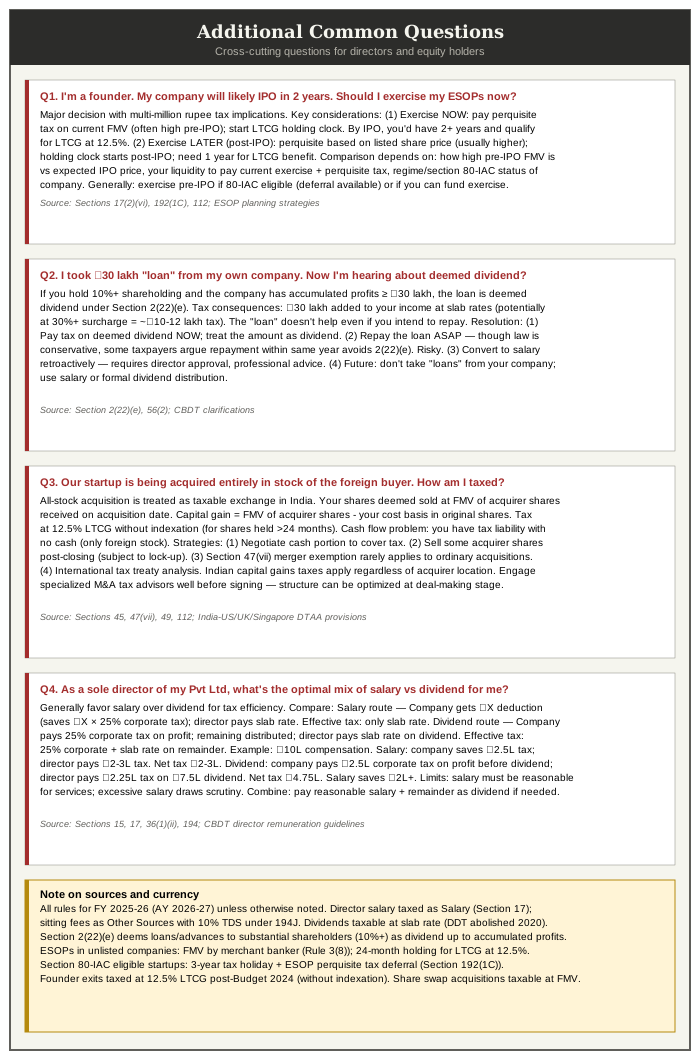
End of lesson — Additional common questions
Key Takeaways
- Director salary is more tax-efficient than dividends for founder-controlled companies: salary route totals ~30% effective tax versus ~47.5% effective (corporate + personal) under the dividend route
- For ESOPs in unlisted companies, FMV at exercise is determined by a SEBI-registered Category I Merchant Banker under Rule 3(8) — not market price — creating valuation disputes and substantial expenses
- Section 80-IAC eligible startups allow ESOP perquisite tax deferral under Section 192(1C) to the earliest of: 5 years from end of FY of exercise, date of selling shares, or date of leaving employment
- Section 2(22)(e) deemed dividend catches loans and advances from closely-held companies to shareholders holding 10% or more equity — taxable at slab rates in shareholder's hands, not as capital gains
- Unlisted shares are long-term if held for more than 24 months; LTCG rate is 12.5% without indexation post-Budget 2024; founder shares with nominal cost basis of ₹10 face massive gains at exit
- Phantom stock and SARs pay cash (not shares) — taxed as salary or business income at slab rates, not at the 12.5% LTCG rate that applies to actual share sales
- Director-shareholders of unlisted companies must file ITR-2 minimum and complete Schedule DI (directorship disclosure) and the unlisted shares schedule for every company they hold shares in
Quiz — 5 Questions
Answer one at a timeUnder Companies Act 2013, what is the maximum sitting fee a director can receive per board meeting?