Tax Planning Strategies
Annual tax planning calendar with quarter-by-quarter actions; Old vs New Regime break-even analysis framework; Section 80C portfolio construction with ELSS vs PPF comparison; Section 80D family health insurance structuring for maximum deductions; home loan planning including joint ownership and let-out designation strategies; NPS strategy across all three sections including 80CCD(2) in New Regime; equity strategies including ₹1.25 lakh annual LTCG harvest and loss harvesting; HUF formation for income splitting with legitimacy tests; pre-retirement planning; year-end March 31 checklist with common traps; and 10 common tax planning mistakes
- Build an annual tax planning calendar with quarter-by-quarter actions to avoid year-end rush and optimize investment timing
- Apply the break-even analysis framework to determine whether Old Regime or New Regime minimizes tax for a given income and deduction profile
- Design an optimal Section 80C portfolio, Section 80D health insurance structure, and NPS strategy that maximizes deductions in the chosen regime
- Implement equity tax strategies including the annual ₹1.25 lakh LTCG harvest, loss harvesting, and Direct vs Regular MF plan optimization
- Evaluate HUF formation for income splitting, identify which income sources legitimately belong to HUF, and recognize the clubbing and scrutiny limitations
- Execute the March 31 year-end checklist, avoid common March-end traps, and identify the 10 most common tax planning mistakes
Tax Planning Strategies
The earlier lessons covered tax rules — what's deductible, what's taxable, what's exempt. This lesson is different. It covers tax planning — the deliberate, strategic decisions throughout the year that legally minimize your tax liability. The distinction matters: knowing the rules is necessary but not sufficient. Two filers with identical income can pay dramatically different amounts of tax based purely on planning choices made months before filing.
Tax planning is not tax evasion. Evasion involves hiding income or claiming false deductions — both illegal. Planning involves structuring your legitimate financial activities to qualify for deductions, exemptions, and lower rates available under the law. The government deliberately created these provisions to encourage specific behaviors (saving for retirement, buying homes, investing in productive assets). Using them as intended is not just legal but expected.
This lesson works through the annual tax planning calendar, the major planning levers available to Indian filers, how those levers combine for different income profiles, and the practical implementation steps. We cover the regime choice optimization framework, Section 80C portfolio construction, home loan structuring, HUF formation for income splitting, and the year-end checklist that captures often-missed last-minute opportunities.
A reminder: this lesson uses Income Tax Act 1961 references applicable to FY 2025-26 income filed as AY 2026-27.
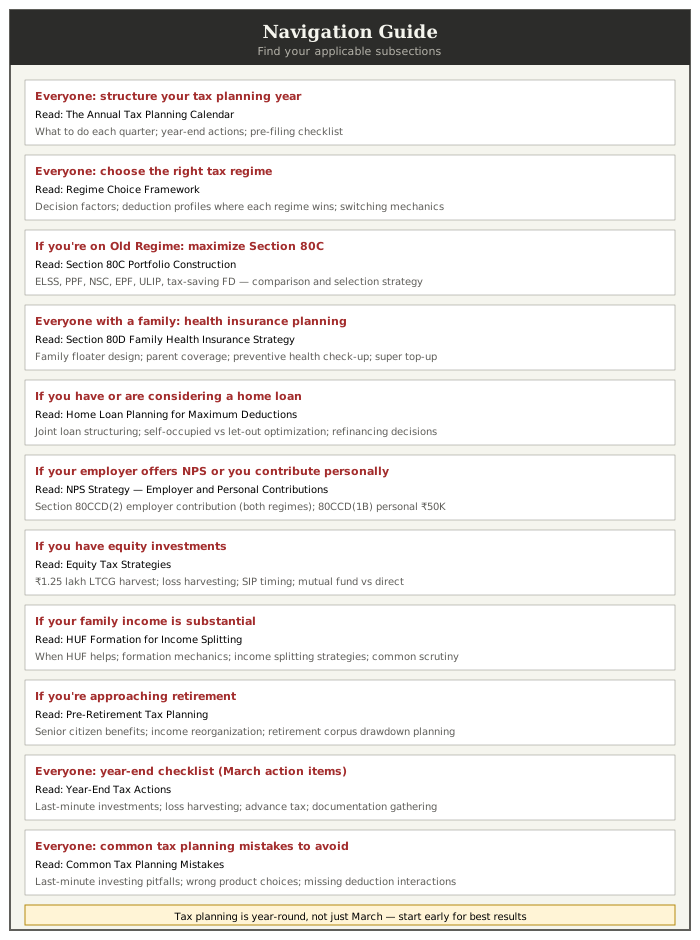
Navigation guide — which subsections apply to your situation
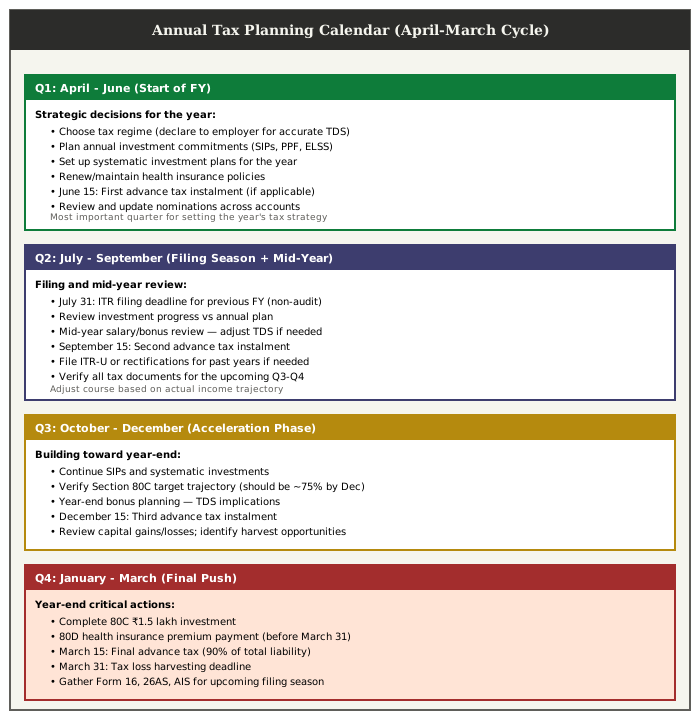
The Annual Tax Planning Calendar
Most filers think about tax in March-July (year-end + filing season). Effective tax planning spreads activities across the full year.
Why early-year planning matters most.
If you wait until February-March to plan tax investments:
- Lump-sum investments in market-linked products (ELSS, equity MFs) face market timing risk
- PPF investment late in year loses interest for the year (interest computed on minimum balance after 5th of month)
- Insurance premium payments may not get processed in time
- Less flexibility in switching strategies
Spread-throughout-year approach.
Better strategy:
- Monthly SIPs in ELSS for ₹12,500 (₹1.5L annual)
- Monthly health insurance EMI (auto-debit)
- Quarterly investment reviews
- Year-end (March) for fine-tuning, not bulk investment
This averages investment costs and removes year-end rush.
CBDT compliance calendar; standard tax planning frameworks.
Regime Choice Framework
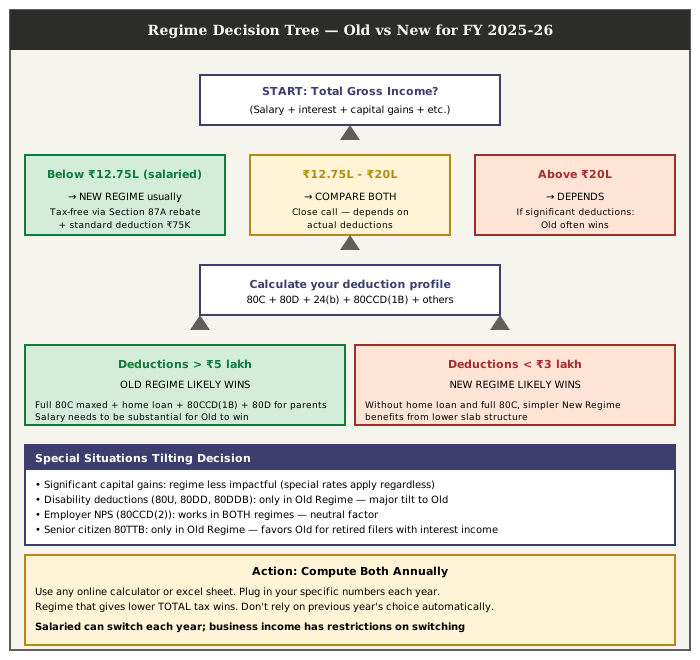
The first strategic decision: Old Regime or New Regime?
Quick decision matrix.
| Profile | Likely Better Regime |
|---|---|
| Salary ≤ ₹12L, few deductions | New Regime (likely tax-free via 87A) |
| Salary ₹12-15L, moderate deductions | Compare carefully — close call |
| Salary ₹15-25L, full ₹1.5L 80C + home loan | Old Regime usually |
| Salary > ₹25L, substantial deductions | Old Regime |
| Salary > ₹25L, minimal deductions | New Regime |
| Senior with primarily slab-rate income | New Regime usually |
| Senior with substantial 80TTB, 80D | Compare carefully |
| Heavy home loan + 80C maxed | Old Regime |
| Pure capital gains income | Less sensitive to regime |
| Self-employed presumptive (44ADA) | New Regime usually |
The break-even analysis approach.
For your specific situation:
- Compute tax under New Regime (standard deduction only).
- List all deductions you actually claim in Old Regime: 80C investments; 80CCD(1B) NPS additional; 80D health insurance; 24(b) home loan interest; HRA exemption (if applicable); Other (80E, 80G, etc.)
- Compute tax under Old Regime with those deductions.
- Compare tax amounts. Lower wins.
Salary ₹18 lakh. Deductions: ₹1.5L 80C + ₹50K NPS + ₹25K 80D + ₹2L home loan interest = ₹4.25L total. New Regime calculation: Income: ₹18 lakh Standard deduction: ₹75,000 Taxable: ₹17,25,000 Tax: ₹0 (0-4L) + ₹20K (4-8L @ 5%) + ₹40K (8-12L @ 10%) + ₹60K (12-16L @ 15%) + ₹25K (16-17.25L @ 20%) = ₹1,45,000 Plus cess 4%: ₹5,800 Total: ₹1,50,800 Old Regime calculation: Income: ₹18 lakh Standard deduction: ₹50,000 Less deductions: ₹4,25,000 Taxable: ₹13,25,000 Tax: ₹0 (0-2.5L) + ₹12,500 (2.5-5L @ 5%) + ₹1L (5-10L @ 20%) + ₹97,500 (10-13.25L @ 30%) = ₹2,10,000 Plus cess 4%: ₹8,400 Total: ₹2,18,400 Result: New Regime saves ₹67,600. Despite substantial deductions, New Regime wins here because of more favorable slab structure for this income range.
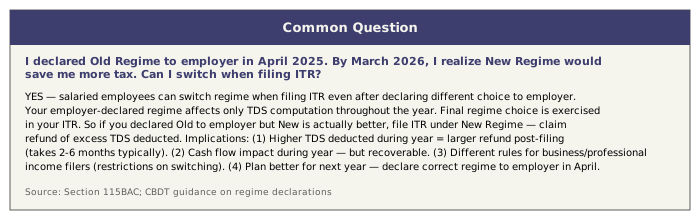
The regime switch mechanics (covered Lesson 5).
- Salaried: switch every year between regimes.
- Business/professional income: switching restricted; once opted for New Regime and switched back to Old, cannot re-enter New until specific conditions.
Sections 115BAC, 87A of Income Tax Act 1961.
Section 80C Portfolio Construction
For Old Regime filers, Section 80C is the foundational deduction. How to fill the ₹1.5 lakh limit optimally?
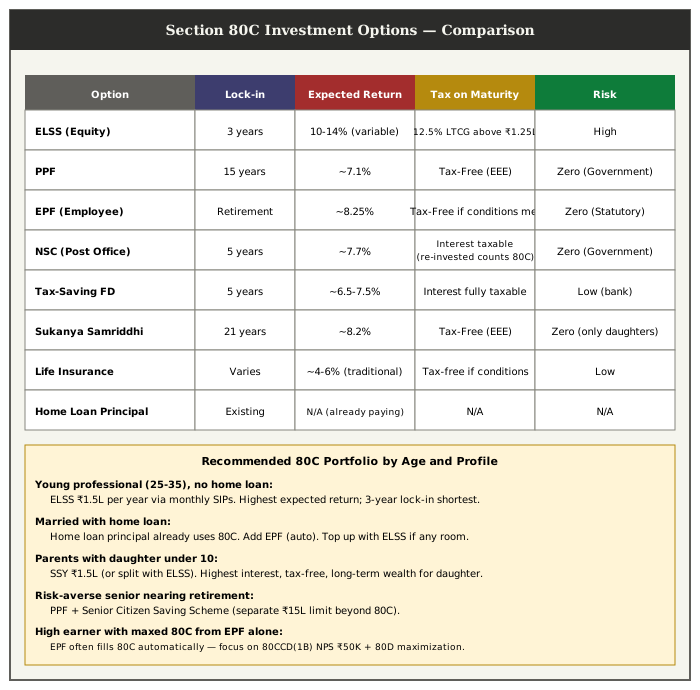
Why ELSS often wins for young professionals.
ELSS combines:
- Tax deduction under 80C
- Equity exposure for long-term wealth creation
- Shortest lock-in (3 years) among 80C options
- Tax-efficient withdrawal (12.5% LTCG above ₹1.25L vs slab rates on FD interest)
For a 30-year-old in 30% bracket investing ₹1.5L annually:
- Tax saved: ₹45,000 per year
- Effective investment cost: ₹1,05,000
- Over 30 years at 12% return: corpus ~₹3.5 crore
- Tax on withdrawal: significantly less than slab rates
Compare to PPF: same ₹1.5L investment, ₹45K tax saved, but ~7.1% return = ~₹1.4 crore corpus over 30 years.
The EPF reality.
Salaried employees often have EPF deduction at 12% of basic salary. For someone with ₹50K basic monthly = ₹72,000 annual EPF contribution. This eats into 80C limit, leaving only ₹78,000 room for other investments.
For high salaries (basic > ₹1L/month), EPF alone may use up 80C limit.
Section 80C of Income Tax Act 1961; various savings scheme regulations.
Section 80D Family Health Insurance Strategy
Beyond just buying insurance, structure family coverage to maximize the 80D deduction.
The deduction structure.
| Category | Maximum Deduction |
|---|---|
| Self + Spouse + Children (all under 60) | ₹25,000 |
| Self + Spouse + Children (any senior 60+) | ₹50,000 |
| Parents (both under 60) | ₹25,000 |
| Parents (any senior 60+) | ₹50,000 |
| Preventive Health Check-up (within above limits) | ₹5,000 |
Maximum combined potential: ₹50,000 (self family with seniors) + ₹50,000 (senior parents) = ₹1,00,000.
Strategy 1: Don't combine self and parents in one policy.
If you buy a single family floater covering self + spouse + children + parents:
- All under one ₹25,000 or ₹50,000 limit
- Lose the separate ₹25,000-₹50,000 parents deduction
Better: Two separate policies. Each gets its own deduction limit.
Strategy 2: Buy in correct names.
For 80D parents deduction, you must:
- Be the proposer/policy holder
- Pay the premium (from your bank account, not cash)
- Parents covered as insured persons
If parents themselves pay premium, you can't claim 80D for it.
Strategy 3: Senior citizen plans.
Many insurers offer senior-specific health plans:
- LIC, Star Health, Care Health offer dedicated senior plans
- Pre-existing disease coverage after waiting period
- Higher premiums but no age cap for renewal
Strategy 4: Super top-up policy.
A super top-up:
- Covers above a deductible (e.g., ₹5 lakh)
- Much lower premium than buying high coverage outright
- Combined with regular policy gives larger coverage cheaply
Premium counts under 80D within applicable limit.
Strategy 5: Preventive health check-up.
The ₹5,000 sub-limit for preventive check-ups:
- Within overall 80D limit
- Includes diagnostic tests, health screening
- Receipts required (from approved diagnostic centers)
- Often unused because filers don't claim it
You're 40, spouse 38, two children (8 and 12), parents 65 and 68. Suboptimal: Single family floater covering everyone. Total premium: ₹35,000 Deduction limit: ₹50,000 (because parents are seniors) Allowed: ₹35,000 Optimal: Two separate policies. Family policy (self+spouse+kids): ₹15,000 premium Senior parents policy: ₹25,000 premium Preventive check-ups: ₹5,000 Deduction: Family: ₹15,000 + ₹3,000 preventive (within ₹25K limit) Parents: ₹25,000 + ₹2,000 preventive (within ₹50K limit) Total deduction: ₹45,000 Higher deduction at similar overall cost.
Section 80D of Income Tax Act 1961.
Home Loan Planning for Maximum Deductions
Home loans offer the largest single deduction opportunity in Indian tax planning. Structure matters.
The deduction stack (Old Regime).
| Deduction | Section | Maximum |
|---|---|---|
| Principal repayment | 80C | ₹1,50,000 (within 80C limit) |
| Interest (Self-Occupied) | 24(b) | ₹2,00,000 |
| Interest (Let-Out) | 24(b) | No upper limit |
| First-time buyer extra | 80EE or 80EEA | ₹50,000 to ₹1,50,000 |
Strategy 1: Joint loan with spouse.
Already covered in Lesson 13 — registration as joint owners + both as co-borrowers + both contributing to EMIs from separate incomes = doubled deductions.
For a couple paying ₹3.5L annual interest:
- Single ownership: ₹2L deduction (cap)
- Joint ownership: ₹4L combined deduction
Annual tax saved difference (30% bracket): ₹60,000.
Strategy 2: Let-out vs Self-Occupied tax planning.
For multiple property owners:
- Designate higher-loan property as Let-Out (interest fully deductible)
- Designate lower-loan property as Self-Occupied (₹2L cap)
- Within Old Regime, this can dramatically increase deductions
Property A: Loan ₹50 lakh, annual interest ₹4 lakh. Property B: Loan ₹30 lakh, annual interest ₹2.5 lakh. Designation A: Property A as SOP, Property B as LOP. A interest claim: ₹2 lakh (capped) B interest claim: ₹2.5 lakh (full) Total interest deduction: ₹4.5 lakh Designation B: Property B as SOP, Property A as LOP. B interest claim: ₹2 lakh (capped) A interest claim: ₹4 lakh (full) Total interest deduction: ₹6 lakh Designation B saves ₹1.5L of taxable income (at 30% = ₹45K tax saving). Even if A is actually your residence, declare B as SOP for tax purposes (if you legitimately stay there sometimes).
Strategy 3: Pre-construction interest spreading.
For under-construction properties (covered Lesson 13):
- Interest paid during construction accumulates
- Claimed in 5 equal instalments starting year of possession
- Plan possession timing if flexible (year-end vs year-beginning has different impact)
Strategy 4: Refinancing decision.
When considering switching home loan to lower interest rate:
- New rate must be substantially lower (typically 0.5%+ difference)
- Processing fees and other charges reduce benefit
- Tenure reduction better than EMI reduction for tax planning
Strategy 5: Top-up loan for legitimate purposes.
A top-up loan against existing home property:
- Used for property purchase/construction/renovation: interest deductible under 24(b)
- Used for other purposes (personal needs): NOT deductible
Many filers take top-up loans for "renovation" but use for other purposes — keep proper records of actual use to support tax claims.
Sections 24(b), 80C, 80EE, 80EEA of Income Tax Act 1961.
NPS Strategy — Employer and Personal Contributions
NPS (National Pension System) offers unique tax benefits across both regimes.
The three NPS sections.
Section 80CCD(1) — Personal contributions (within 80C).
- Up to 10% of salary (or ₹1.5L overall 80C limit)
- Old Regime only
- Already part of 80C, no additional limit
Section 80CCD(1B) — Personal additional ₹50,000.
- Additional ₹50,000 deduction over and above 80C
- Old Regime only
- Direct ₹50K reduction in taxable income
Section 80CCD(2) — Employer contribution.
- Up to 10% of salary (private sector) or 14% (Central government)
- AVAILABLE IN BOTH OLD AND NEW REGIMES
- One of the few deductions surviving in New Regime
Strategy 1: Always opt for employer NPS if offered.
If your employer offers NPS as part of compensation structure:
- 10% of basic + DA contributed by employer
- Tax-free under 80CCD(2)
- Doesn't reduce your take-home (it's additional to salary)
For ₹1 lakh basic salary, employer NPS = ₹10,000/month = ₹1,20,000 annually as additional tax-free retirement contribution.
Strategy 2: Maximize 80CCD(1B) ₹50,000.
For Old Regime filers:
- Section 80C may already be maxed by EPF + ELSS + insurance
- Section 80CCD(1B) provides ADDITIONAL ₹50,000 deduction
- Total tax saving: ₹15,000 at 30% bracket
Strategy 3: Restructure salary to include employer NPS.
If you negotiate your CTC structure:
- Reduce variable pay/bonus slightly
- Increase employer NPS contribution
- Same overall CTC, but tax savings due to 80CCD(2)
For salaried individual at ₹25L CTC in New Regime, shifting ₹2.5L from variable pay to NPS:
- Tax saved: ₹2.5L × 30% = ₹75,000
- Real money in pocket vs locked retirement corpus trade-off
NPS lock-in and structure.
- Lock-in until retirement age (60)
- 60% lump sum at retirement: tax-free
- 40% mandatory annuity: pension taxed at slab rate
Asset allocation.
- Equity (E): up to 75% in active choice
- Government Bonds (G)
- Corporate Bonds (C)
- Alternative Investment Funds (A): up to 5%
Tier I NPS account is the tax-qualified one. Tier II is just an investment account with no tax benefit.
Sections 80CCD(1), 80CCD(1B), 80CCD(2) of Income Tax Act 1961.
Equity Tax Strategies
Specific strategies for equity investors.
Strategy 1: Annual ₹1.25 lakh LTCG harvest.
The Section 112A exemption is per year per filer. If unused, it's gone.
Mechanics:
- Sell shares with embedded LTCG up to ₹1.25 lakh
- Immediately rebuy same shares (Indian tax doesn't have wash sale rules)
- Tax: zero
- Effect: cost basis "reset" to higher level
You hold 200 shares of Reliance bought at ₹2,000 each. Current price ₹2,600. Unrealized gain: ₹600 × 200 = ₹1,20,000. Harvest action: Sell 200 shares at ₹2,600 = ₹5,20,000 Realized LTCG ₹1,20,000 (within ₹1.25L exemption) Tax: ZERO Immediately rebuy 200 shares at ~₹2,600 New cost basis: ₹2,600 per share Cost: tiny brokerage and STT (~₹500-800) Future sale will have lower gain. Repeat annually.
Strategy 2: Equity loss harvesting.
Selling losing positions to realize losses for set-off:
- Identify positions trading below cost
- Sell to crystallize loss
- Loss offsets gains (STCL most flexible — offsets both STCG and LTCG)
- Can rebuy immediately if you still want exposure
Strategy 3: SIP timing for tax efficiency.
SIPs into equity MF:
- Each instalment is separate purchase for holding period
- Cumulative SIP over years creates a mix of long-term and short-term units
- Redemption uses FIFO
- Plan redemptions to maximize long-term units (held >12 months)
Strategy 4: Direct vs Regular MF plans.
Direct plans (no broker commission):
- Lower expense ratio (~0.5-1.0% lower)
- Same tax treatment
- Significant compounding benefit over 10+ years
For ₹10 lakh investment over 20 years at 12%:
- Regular plan (1.5% expense): ~₹85 lakh corpus
- Direct plan (0.5% expense): ~₹98 lakh corpus
- Difference: ₹13 lakh from same input
Always opt for Direct plans where possible. Tax treatment identical.
Strategy 5: Dividend vs Growth options.
Mutual fund dividend options:
- Dividend payouts trigger TDS (10%) and taxed at slab rates
- Growth option: NAV grows; tax only on redemption
- Growth typically more tax-efficient for HNI investors
Direct equity dividends similarly taxed in post-2020 regime.
Sections 112A, 70, 71 of Income Tax Act 1961.
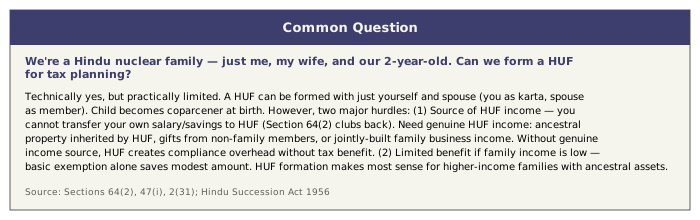
HUF Formation for Income Splitting
For families with substantial income, Hindu Undivided Family (HUF) provides a separate tax entity.
What is HUF.
A HUF is a separate "person" under Indian tax law:
- Has its own PAN
- Files its own ITR (ITR-2 or ITR-3)
- Gets its own basic exemption (₹2.5L Old / ₹4L New)
- Same slab rates as individuals
- Same 80C, 80D, etc. deductions
Who can form HUF.
Only Hindu families (and Sikh, Jain, Buddhist by inclusion). Christians and Muslims cannot form HUF. Most relevant for those whose personal law is Hindu Succession Act.
Formation requirements.
- Karta (head) — typically eldest male, but females can be karta after 2005 amendments
- Coparceners (descendants by birth)
- Members (spouses of coparceners)
- Initial corpus (gift, ancestral property, or other)
Tax benefits.
Benefit 1: Additional basic exemption.
Each individual gets basic exemption (₹4L New / ₹2.5L Old). HUF gets its own separate exemption. For high-income families, this is an additional tax-free bracket.
Benefit 2: Income splitting.
Income earned by HUF property/business is taxed in HUF's hands. Not added to individual karta's income.
Benefit 3: Separate deduction limits.
HUF can independently claim:
- 80C ₹1.5 lakh (additional to individual's ₹1.5L)
- 80D health insurance (for HUF members)
- 80G donations
- 24(b) home loan interest (if HUF owns property with loan)
Family with karta earning ₹40 lakh from salary. Family also has ₹15 lakh rental income from inherited ancestral property. Without HUF structure: All ₹55 lakh assessed in karta's hands Higher slab rates apply Estimated tax: ~₹14-15 lakh With HUF structure: Inherited property transferred to HUF (Section 47 applies — no transfer tax) ₹15 lakh rental income in HUF's hands Karta's individual income: ₹40 lakh (lower slab impact) HUF tax on ₹15 lakh: ~₹2 lakh Karta tax on ₹40 lakh: ~₹9 lakh Combined: ~₹11 lakh Saving: ~₹3-4 lakh annually
Limitations and risks.
Limitation 1: Karta's spouse not a coparcener (under classical interpretation).
Karta's spouse is a member (gets HUF benefits) but not coparcener (no inherent share). Recent Supreme Court rulings have expanded female rights — consult specialist for current position.
Limitation 2: Income clubbing for individual transfers to HUF.
If individual transfers their personal income/assets to HUF without consideration, income may be clubbed back per Section 64(2).
To genuinely create HUF income:
- Gift from non-family member to HUF (legitimate addition)
- Ancestral property (legitimate HUF income)
- Income from HUF business (legitimate)
Limitation 3: Scrutiny risk.
HUF formed only for tax planning without genuine family economic activity faces scrutiny:
- Sources of HUF income must be verifiable
- Members must genuinely benefit from HUF assets
- Documentation of HUF creation, gifts, etc., essential
Limitation 4: Partition tax implications.
When HUF eventually partitions among members:
- No tax at partition (Section 47(i))
- Each member receives their share
- Future income from received share is their individual income
When HUF makes sense.
- Family income > ₹30 lakh
- Ancestral or inherited property exists
- Long-term family wealth planning
- Family business operations
- Multi-generational asset transfer
When HUF doesn't help.
- Income from personal employment only
- Single individual with limited family structure
- Future risk of partition disputes
- Inadequate documentation possible
Sections 47(i), 64(2), 2(31) of Income Tax Act 1961; Hindu Succession Act 1956.
Pre-Retirement Tax Planning
The 5-10 years before retirement offer unique planning opportunities.
Strategy 1: Aggressive retirement contribution.
In final working years:
- Max out NPS contributions (employer + personal)
- Voluntary EPF contributions (up to 100% of basic salary)
- ELSS for tax-efficient equity exposure
- PPF reaching maturity
The goal: build retirement corpus while still in high-tax bracket. Withdrawal in retirement at lower tax bracket.
Strategy 2: Income recognition timing.
If you have flexibility:
- Defer income (bonuses, capital gains) to retirement years (lower tax bracket)
- Accelerate deductions in pre-retirement years (high bracket)
Strategy 3: Property planning before senior citizen status.
Selling property before turning 60 vs after:
- 60+ gets various senior benefits but not capital gains relief
- Plan property exits when most tax-efficient regardless of age
Strategy 4: Health insurance switch to senior-specific.
Before 60:
- Lock in lower-premium senior-friendly health plans
- Maintain continuous coverage (preexisting disease waiting periods)
- Move to comprehensive senior coverage as you approach 60
Strategy 5: SCSS planning post-retirement.
Senior Citizen Saving Scheme:
- ₹30 lakh limit (post-Budget 2023 enhancement)
- ~8.2% interest, quarterly payouts
- 5-year tenure, extendable 3 years
- Highest fixed-income return for seniors
Plan to invest retirement lump sum here for guaranteed senior income.
Various sections of Income Tax Act 1961; senior citizen welfare provisions.
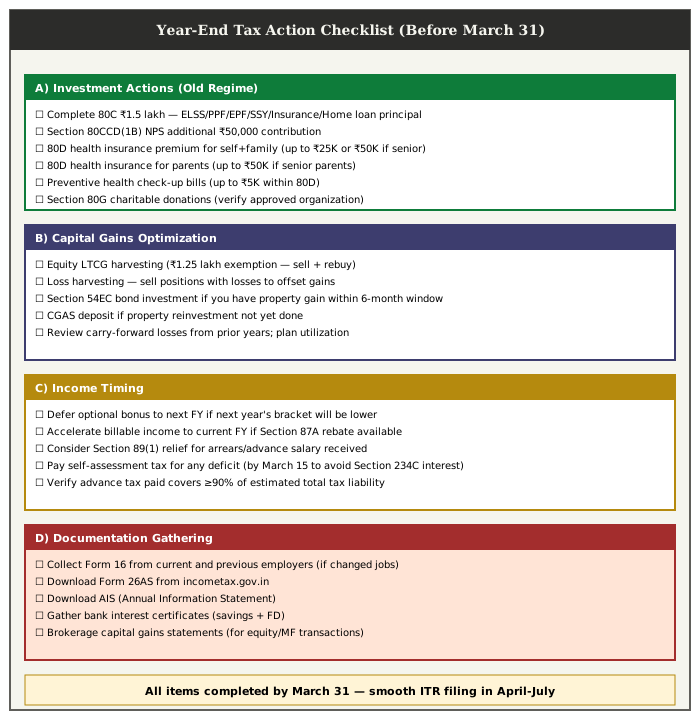
Year-End Tax Actions
The March 31 checklist of last-minute tax actions.
By March 31 (year-end deadline):
Investment actions:
- Complete 80C ₹1.5 lakh target investments
- Pay 80CCD(1B) NPS ₹50,000 (if Old Regime)
- Pay 80D health insurance premiums for the year
- Make any pending charitable donations (80G)
- Complete tax-saving fixed deposits
Capital gains actions:
- Final tax loss harvesting (sell losing positions to realize losses)
- ₹1.25 lakh LTCG harvesting (sell winners up to exemption)
- Consider Section 54EC bond investments if you have property gains within 6-month window
Income recognition:
- Defer optional bonus to next year if currently in high bracket
- Recognize income in current year if next year will be higher bracket
Pre-March 15 actions:
- Pay final advance tax instalment (90% of total tax)
- Adjust if any major income events expected before March 31
Documentation gathering (start before March 31, continue into April):
- Salary slips and Form 16
- Bank statements showing interest
- TDS certificates from various deductors
- Investment proof receipts (for 80C, 80D, etc.)
- Rent receipts for HRA
- Home loan interest certificates
- Capital gains statements from brokers
- Medical bills for 80DDB
- Disability certificates
Common March-end traps.
- Trap 1: Buying ELSS on March 30-31. NAV may move significantly. Better to systematically invest throughout year.
- Trap 2: Paying insurance premium April 1 instead of March 31. One day difference moves deduction to next FY. Verify processing date.
- Trap 3: Capital gains realization timing. Selling on March 31 vs April 1 may move tax to different FY with different brackets/regime applicability.
- Trap 4: Forgetting CGAS deposit. For property sales in current FY where reinvestment not yet done, CGAS deposit before ITR deadline.
April-July actions (pre-filing):
- Consolidate all documentation
- Reconcile AIS/TIS with your records
- Compute self-assessment tax if any
- File ITR by deadline
General tax compliance and planning practices.
Common Tax Planning Mistakes
Patterns observed across many filers.
Mistake 1: Wrong product for the goal.
Buying ULIP or endowment policy for tax saving when:
- Long lock-in not aligned with goals
- Returns far below market alternatives
- Insurance need not properly evaluated
Better: Term insurance for protection + ELSS for tax + investment goals.
Mistake 2: Last-minute tax investing.
Rushing to invest in February-March:
- Market timing risk for equity products
- Reduced flexibility in product selection
- Risk of choosing suboptimal products under time pressure
Mistake 3: Not reviewing regime annually.
Choosing one regime and never reconsidering:
- Salary growth changes optimal regime
- New deductions (home loan, children) shift calculation
- Regime choice should be reviewed each year
Mistake 4: Missing HRA documentation.
Claiming HRA without proper:
- Rent receipts with revenue stamp (above ₹3,000/month)
- Landlord PAN (if rent > ₹1L per year)
- Rental agreement
- Bank transfers showing rent payment
These trigger scrutiny notice for HRA disallowance.
Mistake 5: Mixing personal and business expenses.
For self-employed:
- Using personal vehicle for business without proper apportionment
- Paying personal expenses through business account
- Claiming questionable expenses
Maintain clean separation of personal and business finances.
Mistake 6: Missing TDS credit reconciliation.
Not reconciling Form 26AS with actual TDS:
- Lost refunds
- Mismatch notices from CPC
- Future scrutiny if substantial discrepancies
Mistake 7: Not filing ITR thinking income is low.
Even when income is below taxable threshold:
- TDS refunds lost
- Carry-forward losses lost
- Loan/visa documentation harder
File ITR even when not strictly required, especially with TDS deducted.
Mistake 8: Ignoring AIS data.
Annual Information Statement (AIS) contains transaction data:
- High-value transactions
- Securities transactions
- Property registrations
- Foreign remittances
Ignoring AIS leads to mismatch notices. Always reconcile AIS with your records before filing.
Mistake 9: Inadequate documentation for unconventional deductions.
For deductions less common (80DDB, 80DD, 80U, etc.):
- Get and keep prescribed certificates
- Maintain expense documentation
- Update certificates as required
Without proper documentation, deduction denied during scrutiny.
Mistake 10: Not considering family's combined tax position.
Tax planning in isolation per individual:
- Joint ownership opportunities missed
- HUF benefits not explored
- Income shifting opportunities missed
- Insurance/health planning across family suboptimal
Family-level tax planning generally beats individual-only approach.
Common patterns from tax practice; CBDT compliance guidance.
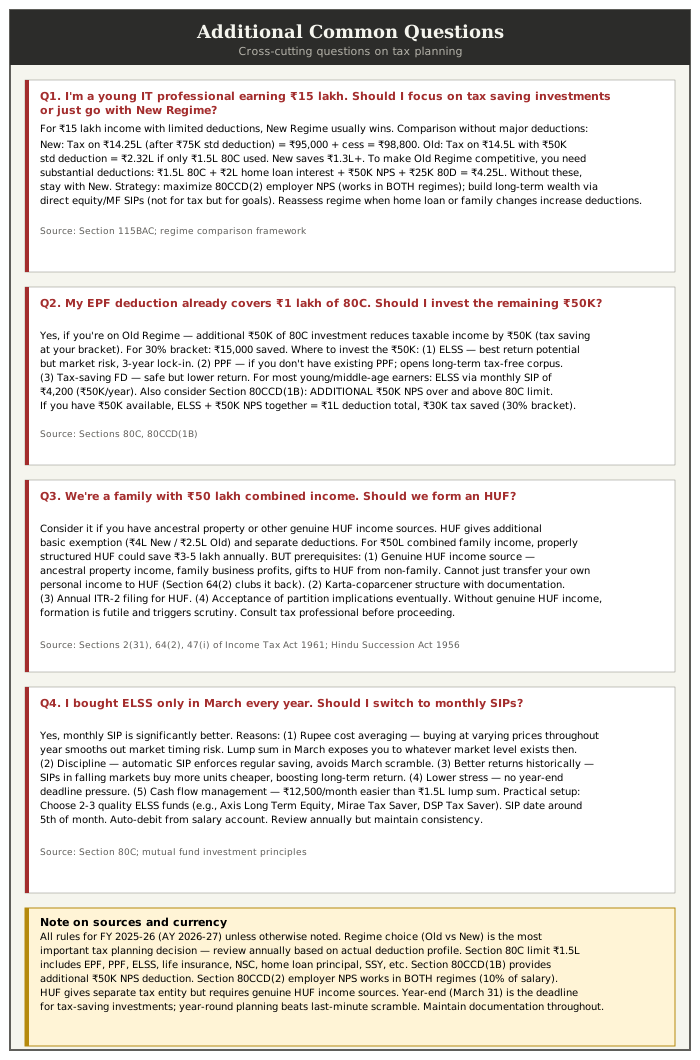
End of lesson — Additional common questions
Key Takeaways
- Annual tax planning beats year-end rush: spread 80C investments via monthly SIPs, set up health insurance auto-debit, and use March only for fine-tuning — lump-sum March investing creates market timing risk for ELSS and forfeits PPF interest (computed on minimum balance after 5th of month)
- Old vs New Regime needs break-even analysis each year: salary growth and new life events (home loan, children) shift the optimal choice; salaried employees can switch every year, but business/professional income filers face re-entry restrictions
- Section 80C: for young professionals, ELSS typically beats PPF — shortest lock-in at 3 years, equity returns, 12.5% LTCG withdrawal vs slab rates on FD interest; salaried employees must subtract EPF (12% of basic) from the ₹1.5L limit before choosing additional products
- Section 80CCD(2) employer NPS contribution survives in both Old and New Regime — it is the highest-leverage deduction for New Regime filers; restructuring CTC to increase employer NPS contribution keeps take-home unchanged while saving tax
- HUF is powerful for families with ancestral property or HUF business but does not help salaried-only nuclear families: transferring personal salary or personal assets to HUF without consideration triggers Section 64(2) clubbing; genuine HUF income requires ancestral property, gifts from non-family members, or HUF business activity
- The annual ₹1.25 lakh LTCG harvest resets equity cost basis at zero tax cost — India has no wash sale rule, so immediate rebuy is permitted; STCL is more flexible than LTCL (offsets both STCG and LTCG) and should always be harvested before year-end
- March 31 year-end discipline: four traps cost money — ELSS NAV timing risk on last 2 days, insurance premium processing date (April 1 payment = next FY), capital gains realization crossing FY boundaries, and CGAS deposit deadline for property gains where reinvestment is pending
Quiz — 6 Questions
Answer one at a timeA salaried employee has ₹50,000 monthly basic salary. Their employer deducts EPF at 12% of basic salary. How much 80C space remains for other tax-saving investments?